
Your house is still standing, more or less. The roof held over two rooms, the kitchen is charcoal, and an adjuster you met once has handed you a number. It sounds like a lot of money until you call a contractor. Most fire-damaged properties get stuck in the gap between what the check says and what the builder says. The cost to rebuild is almost never the number printed on the first estimate.
I’ve bought houses in every condition you can picture. Burned ones teach you something the others don’t. The structure is usually the easy part.
What Is Fire Restoration and When Do You Need Fire Reconstruction Instead?
Your house needs one or the other, and that choice shapes every number that follows.
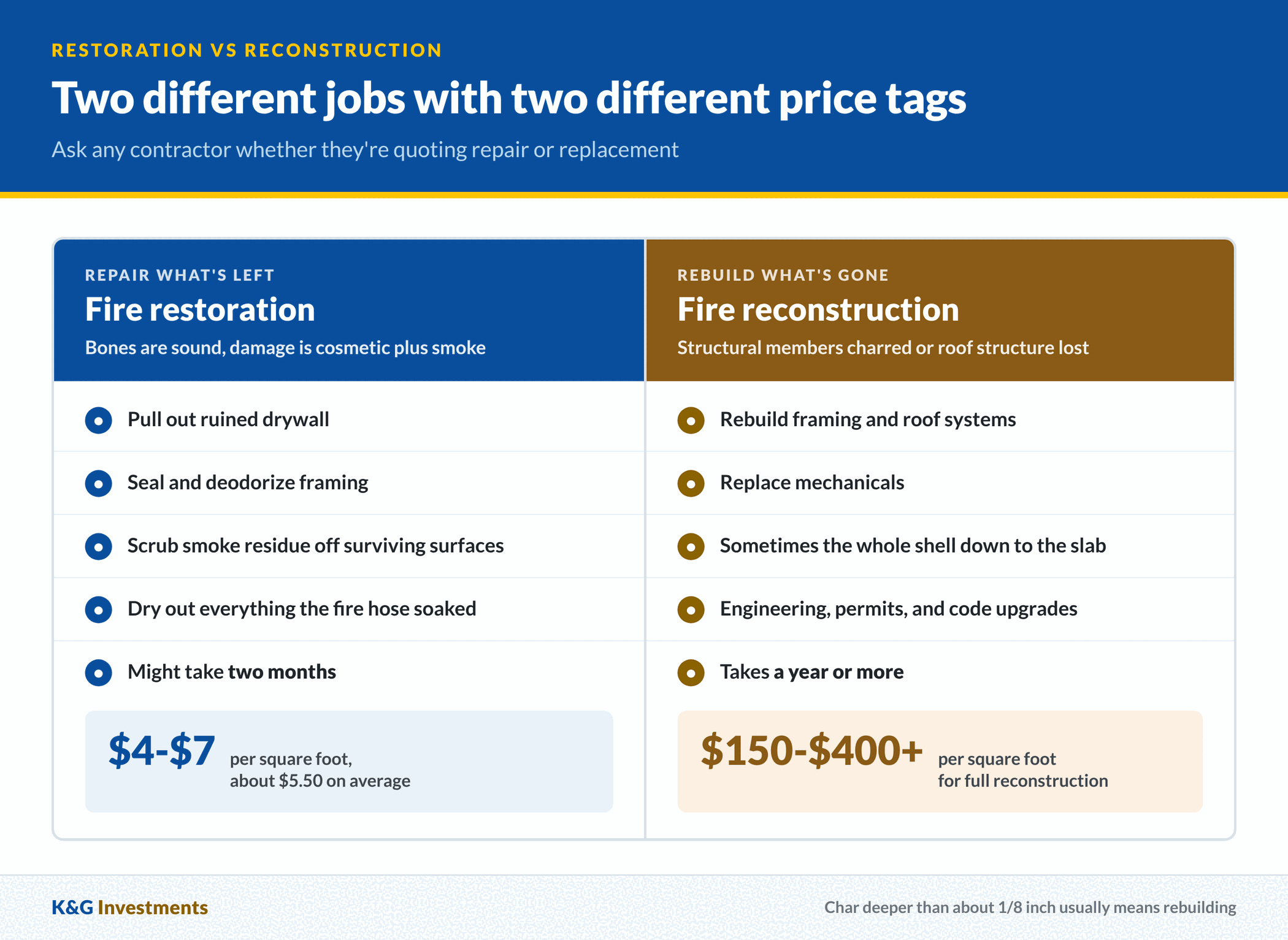
Restoration is cleanup and repair work. Crews pull out ruined drywall, seal and deodorize framing, and scrub smoke residue off the surfaces that survived. They also dry out everything the fire hose soaked. Reconstruction means rebuilding what’s gone: framing, roof systems, mechanicals, and sometimes the whole shell down to the slab.
On walk-throughs I use a rough test. If the structural members char deeper than an eighth of an inch or so, you’re not restoring anything. You’re building.
Water damage usually settles the question before the fire does. Firefighters move fast, and they move a lot of water. That water sits in wall cavities and subfloor for days before anybody opens the house back up. Mold starts in a weekend. A home with light smoke in the bedrooms and three inches of standing water in the basement often costs more than one with a hotter, drier burn contained to a single room.
Fires like this aren’t rare. NFPA counted 329,500 home structure fires in 2024, causing $11.4 billion in direct property damage. That comes from NFPA’s fire loss research, and it includes everything from a stovetop flare-up to a total loss.
Last year a retired couple called me about their late father’s house. He’d moved into assisted living a few months before an electrical fire took out the back half. The two of them were driving ninety minutes each way to meet contractors. His garage full of woodworking tools still needed sorting, too. Rebuilding was never realistic for them. They were going to lose a year.
People get the order wrong all the time. They hire a restoration company before they know which category their house falls into. Restoration firms do restoration. Walk one through a house that needs reconstruction, and you’ll get a bid for phase one of a four-phase job. The cost to rebuild shows up later as a change order you didn’t budget for. Ask every contractor you interview to say plainly whether they’re quoting repair or replacement.
How Much Does It Cost to Rebuild a House After a Fire?
Get this estimate wrong and you’ll sign a construction contract you can’t fund. You’ll discover the shortfall around month four. Then you’ll end up selling a half-finished house for less than the lot was worth before the fire.
Standard construction runs about $150 to $250 per square foot nationally. The National Association of Home Builders tracks this in its Cost of Constructing a Home survey. It puts construction of a typical new single-family home at $162 per square foot for a 2,647-square-foot house, before land and contractor overhead. Add the general contractor’s markup and that figure climbs closer to $195.
After a fire, your cost to rebuild sits above those numbers every time.
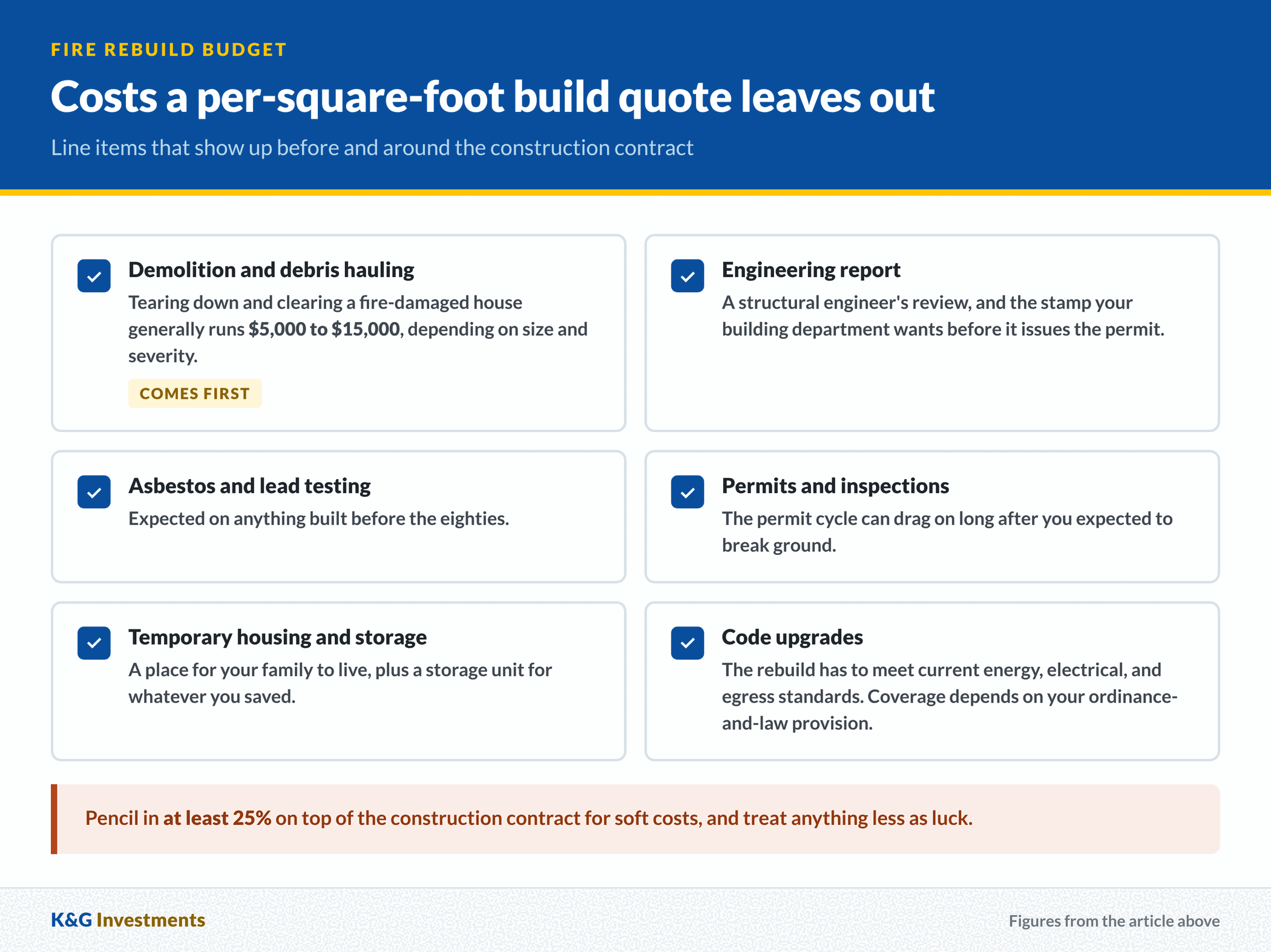
Demolition and debris hauling come first, and nobody includes them in a per-square-foot build quote. Tearing down and clearing a fire-damaged house usually runs $5,000 to $15,000, depending on size and severity. Then come the engineering report, the asbestos and lead testing on anything built before the eighties, and the permit cycle at your building department. I’ve watched that last step drag on long after the homeowner expected to break ground.
Partial rebuilds, where the foundation and some framing survive, often come in cheaper per foot than full reconstruction. That isn’t always good news. Working around salvaged structure is slower than starting clean. A contractor who has to match new framing to old, out-of-plumb walls will price that complexity in.
Soft costs sink more budgets than anything else. Most homeowners forget half of them exist until the bills show up: architect, structural engineer, permits, inspections, temporary housing, and a storage unit for whatever you saved. I’d tell any homeowner to pencil in at least twenty-five percent on top of the construction contract and treat anything less as luck.
Code upgrades are mandatory. Your 1962 house wasn’t built to current energy, electrical, or egress standards, and the rebuild has to be. Some insurance policies cover this under an ordinance-and-law provision and some don’t. Depending on which one you hold, the total cost to rebuild can swing by tens of thousands.
What Factors Affect the Cost to Rebuild After Fire Damage?
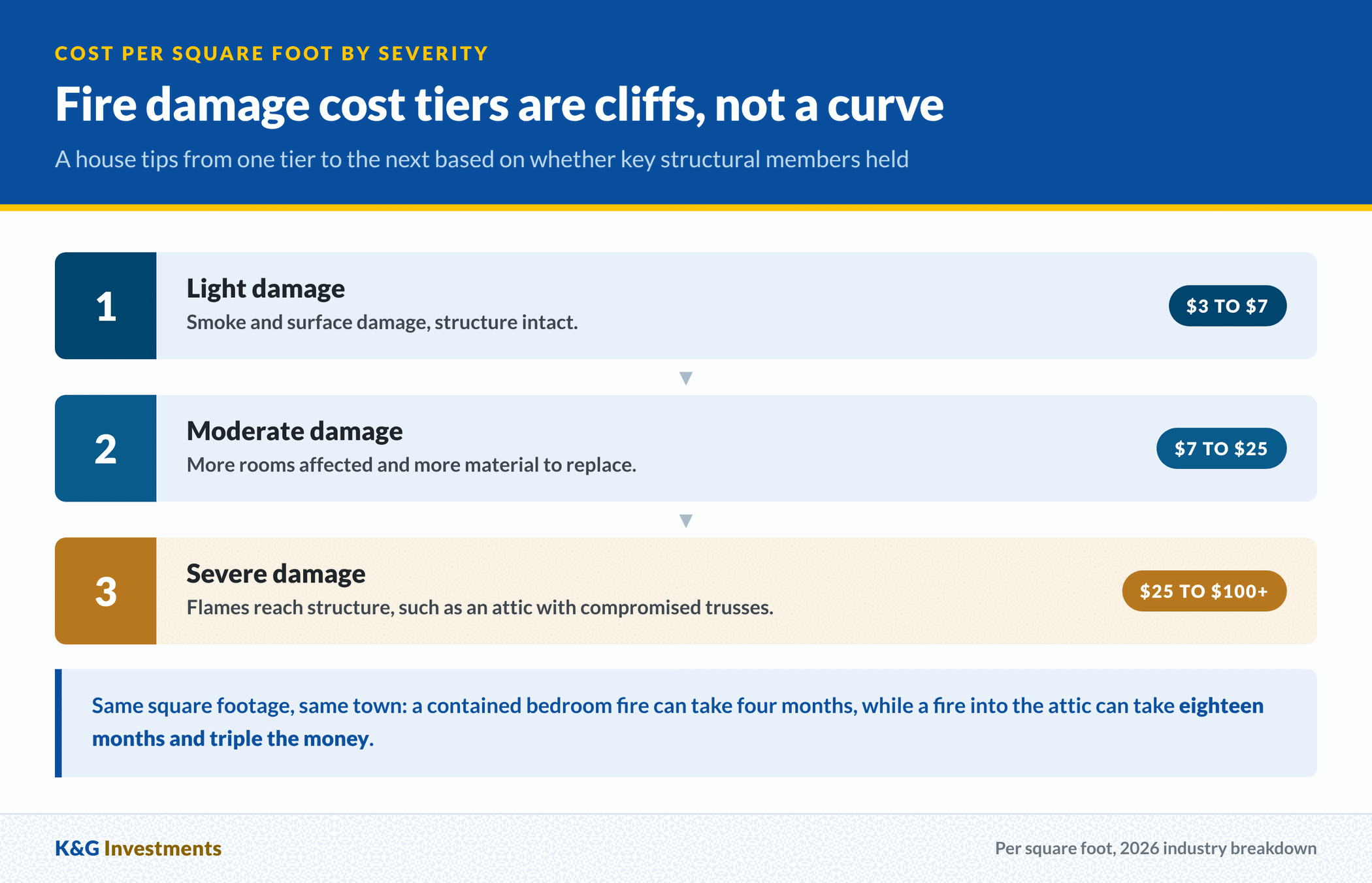
Picture a ranch house with a contained bedroom fire, smoke through the hallway, and the framing intact. That’s four months and a manageable bid. Same square footage, same town, but the flames reached the attic and compromised the trusses. Now it’s eighteen months and triple the money.
Severity drives everything else. One 2026 industry breakdown puts light damage at roughly $3 to $7 per square foot, moderate damage at $7 to $25, and severe damage at $25 to $100 or more, per Bayco Builders. Those tiers don’t form a smooth curve. They’re cliffs. A house tips from one to the next depending on whether a few key structural members held.
Where you live changes the math more than most budgets allow for.
Labor markets for rebuild crews swing wildly from region to region. A framing crew in rural Alabama and a framing crew in coastal California aren’t priced anywhere near each other. In wildfire-rebuild zones, the whole trade pool gets bid up at once, because hundreds of neighbors need the same crew in the same eighteen months. Southern California homeowners have lived this since the 2025 fires, when local contractor pricing broke away from any national benchmark.
Age of the house pushes the cost to rebuild up in ways most owners don’t expect. Knob-and-tube wiring, plaster-and-lath walls, original hardwood, and a chimney built before modern flue codes all cost more to replicate or replace than their modern versions.
Your timeline is a cost factor, too. Homeowners who can wait out slow bidding and a long permit queue get better pricing. Homeowners carrying a mortgage, a rental payment, and a deadline from their insurer’s additional-living-expense coverage don’t have that luxury.
Smoke travels where fire doesn’t. HVAC ductwork pulls soot into rooms that never saw a flame, and the odor settles into insulation and subfloor until someone removes it. Half-measures here fail. The smell comes back every spring, and every buyer notices.
How Much Does It Cost to Rebuild a House Per Square Foot After a Fire?
A seller called me with three contractor bids spread across her kitchen table. They ranged from $190 to $410 per square foot for the same scope of work on a 1,900-square-foot house. She wanted to know which one was lying.
None of them was, as it turned out. Each one had scoped a different job, and that’s the trap in per-square-foot pricing.
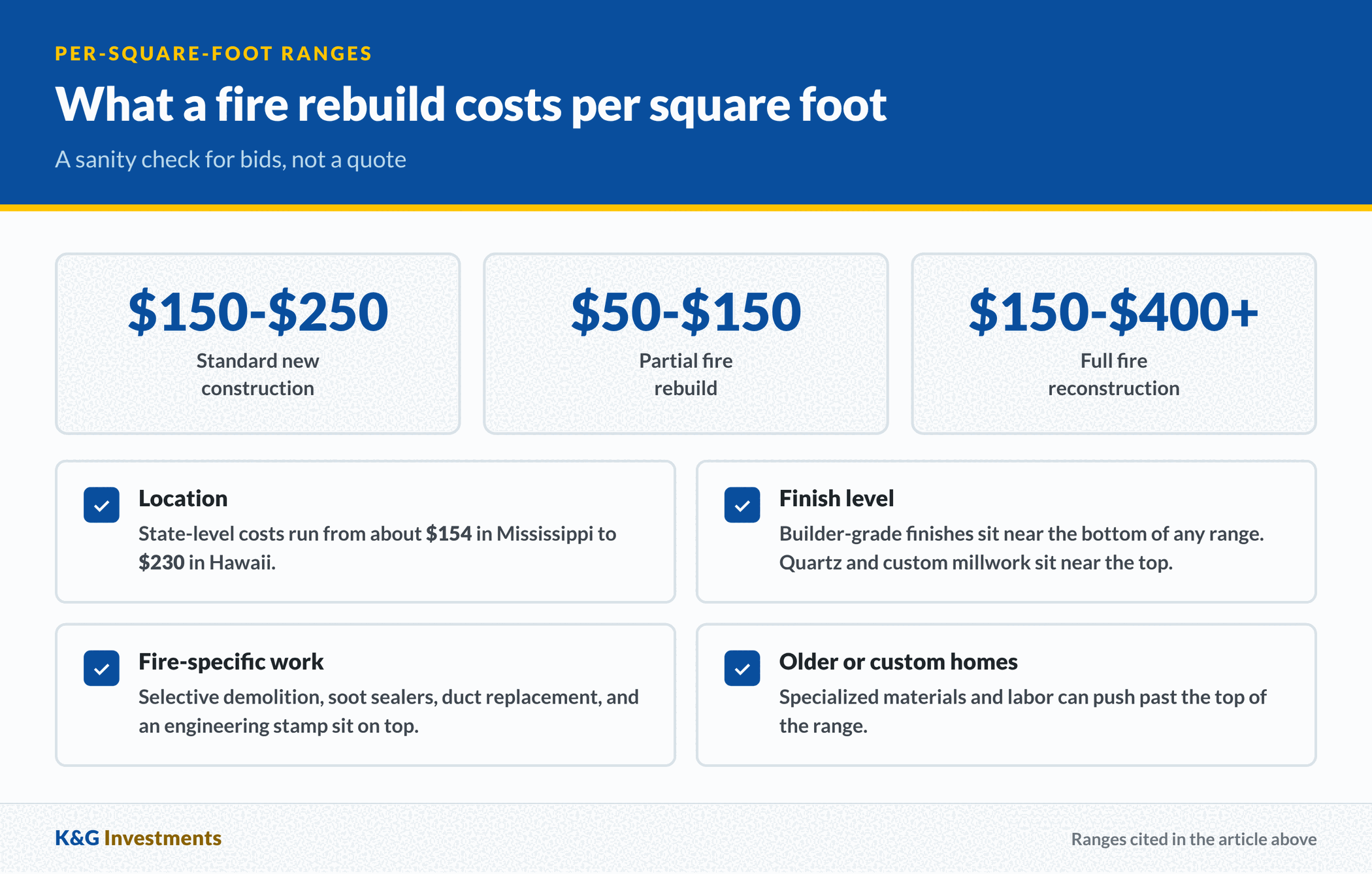
Fire reconstruction lands in a wide band, so expect a range rather than a clean number. A partial rebuild commonly runs $50 to $150 per square foot. Full reconstruction runs $150 to $400 and up, and older or custom homes push past that because of specialized materials and labor. Multiply the middle of that range by a 2,000-square-foot house, and that cost to rebuild will keep you up at night.
Per-square-foot figures are a sanity check, not a quote. Use them to spot a cost to rebuild that’s wildly out of line. Then set them aside when you’re actually choosing a contractor.
Finish level swings the number a lot. Builder-grade cabinets, laminate counters, and vinyl windows sit near the bottom of any published range, while quartz, custom millwork, and real tile sit near the top. The decision most homeowners regret is upgrading finishes during a fire rebuild because a construction loan is open anyway. Then they run out of money before the HVAC is even balanced.
Construction costs also swing with where you’re building. State-level costs run from about $154 per square foot in Mississippi to $230 in Hawaii, roughly a 49 percent gap. California markets routinely price above both.
Fire-specific work goes on top of that: selective demolition, soot encapsulation sealers, duct replacement, and the structural engineering stamp your building department will want before it issues the permit. After a fire, the cost to rebuild per square foot sits well above the same house built new on a clean lot. That makes no sense until you’ve watched a crew hand-demo a kitchen they can’t just bulldoze.
Fire Damage Restoration vs Fire Damage Reconstruction: What’s the Cost Difference?
“Just clean it up and sell it, right?” I hear that all the time, and on maybe one house in five it’s the right call.
Fire damage restoration averages around $5.50 per square foot, with a working range of $4 to $7 depending on the damage type and extent, according to Angi’s 2026 cost data. Rebuilding costs several times that, so the math looks simple at first.
Paper isn’t where this gets decided.
Restoration only works if the bones are sound and the damage is truly cosmetic plus smoke. Once a load-bearing wall is compromised or the roof structure has charred through, restoration contractors will walk away, and they’re right to. A restoration bid on a house that needs reconstruction is just the first invoice.
Hybrid jobs are the most common outcome and the hardest to budget. You restore the front two-thirds, rebuild the rear addition, and tie the new roof into the old one. You pay restoration pricing on part of the house and reconstruction pricing on the rest. Then there’s a premium for the seam where they meet.
Mid-range work falls in between, and nobody advertises it. Ordinary combustible fires involving wood, paper, and plastics run roughly $9,000 to $14,000 to restore in a 2,500-square-foot home. That number is worth knowing. It shows what a contained, single-room fire with good containment looks like financially.
My opinion, for what it’s worth: the restoration-versus-reconstruction debate gets framed as a money question when it’s usually a time question. Restoration might take two months. Reconstruction takes a year or more. During that year you’re paying a mortgage on a house you can’t live in, plus rent on one you can. Run that carrying cost before you compare the two bids, because the cost to rebuild often exceeds the difference between them.
Does Insurance Cover the Full Cost to Rebuild a Fire-damaged Home?
That leaves the insurance check, and whether it’s enough.
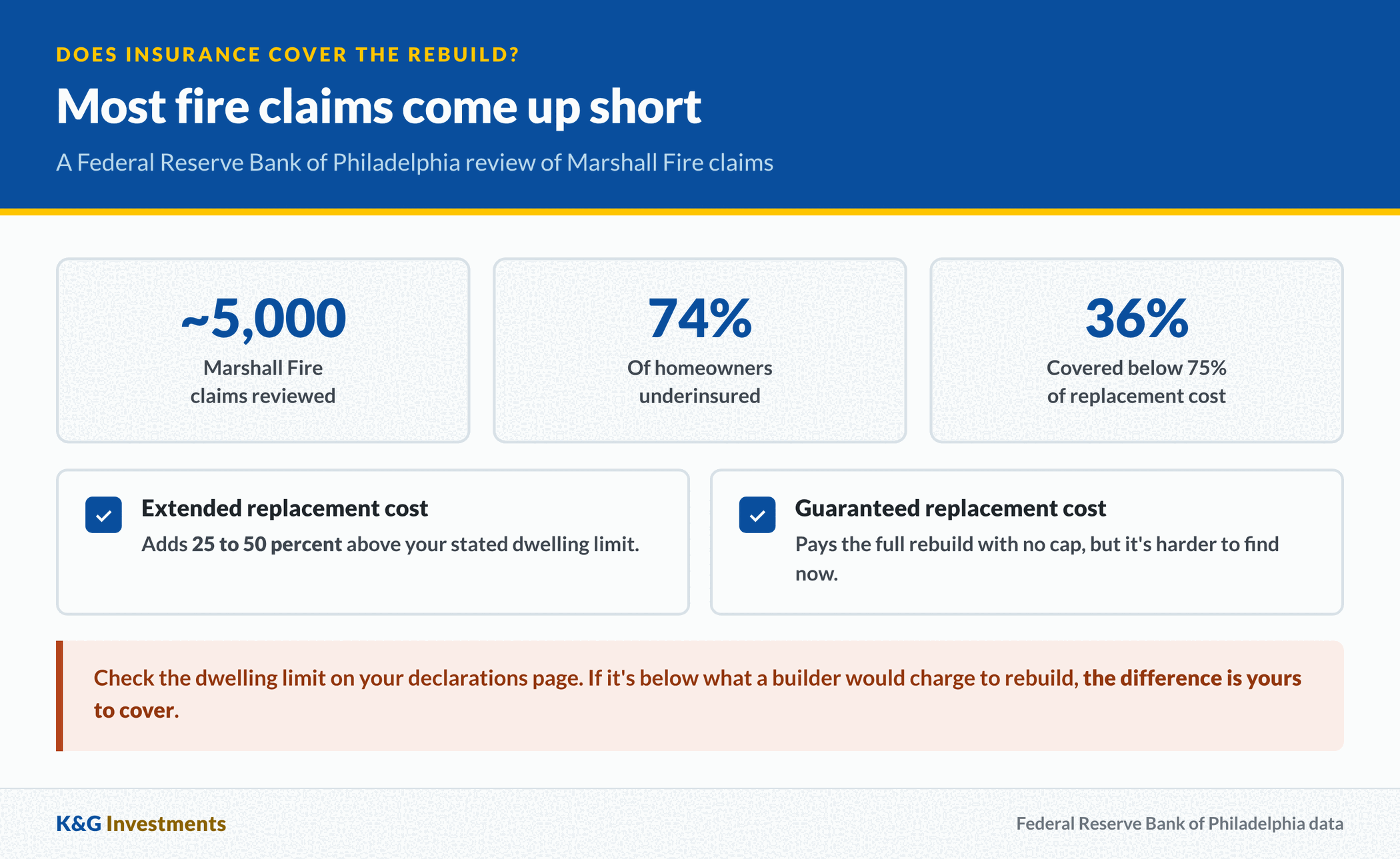
Usually it isn’t. A Federal Reserve Bank of Philadelphia working paper reviewed roughly 5,000 Marshall Fire claims. It found 74 percent of those homeowners underinsured, with 36 percent carrying coverage below 75 percent of replacement cost. MoneyGeek summarized those findings in an analysis updated May 2026.
Why so many policyholders come up short isn’t a mystery. Dwelling limits get set once, when the policy starts. They drift up by a small inflation factor each renewal, even though construction pricing moves faster. A recent analysis of California claims data points at a different culprit. It argues the bigger driver is the replacement cost estimate the insurer hands you when you buy the policy, not homeowners trimming limits to save on premiums. United Policyholders covered that study in September 2026.
Two endorsements help. Extended replacement cost adds 25 to 50 percent above your stated limit, and guaranteed replacement cost pays the full rebuild with no cap. Guaranteed coverage is harder to find now, especially in fire-prone regions. A lot of insurance companies have quietly stopped offering it.
Check your declarations page today, not after a fire. Your dwelling limit is a single line. If it’s below what a builder would charge to rebuild your house from the slab up, that difference is yours to cover.
A landlord I worked with inherited a duplex from his mother, along with thirty years of her belongings. That included a basement full of canning jars and two siblings who wanted their share by Christmas. The upstairs unit had a kitchen fire years earlier that was half-repaired and never finished. When the insurance payout came up short against the real cost to rebuild, he didn’t want to spend eighteen months refereeing his family. He sold the building as-is instead. Clean exit, everyone paid, and nobody stopped speaking to anybody.
That’s often the right ending. If insurance proceeds plus whatever you can borrow don’t cover the cost to rebuild, selling the property in its current condition is a sound financial decision. It isn’t a surrender. Investors like our team at K&G Investments buy fire-damaged houses as they sit. You keep the insurance settlement and skip the construction entirely. Whether that beats rebuilding depends on your equity, your policy, and how much of your life you want to spend managing a job site.
Frequently Asked Questions
Will My Insurance Company Pay for Code Upgrades During the Rebuild?
Only if your policy includes ordinance-and-law coverage, and the amount varies by carrier and by state. Some states now require insurers to offer this coverage as a percentage of the dwelling limit before issuing a replacement-cost policy. Ask your agent whether you carry it and at what level. Without it, bringing a decades-old house up to current electrical, energy, and egress standards comes out of your own pocket.
Can I Sell a Fire-damaged House Before Finishing the Repairs?
Yes, and a lot of owners do. Traditional buyers with mortgages generally can’t close on a house that isn’t habitable. That leaves cash buyers and investors, who price the property based on what the cost to rebuild will be for them. Disclose the fire and the extent of the damage in writing. Every state has disclosure rules, and hiding a fire history creates problems that outlive the closing.
How Long Does a Full Fire Rebuild Usually Take?
Plan on a year or more for a substantial reconstruction, longer if your area is handling many rebuilds at once and the permit office is backed up. The construction itself is often the shortest phase. Claim adjustment, engineering, design, and permitting eat months before a single nail goes in. Budget temporary housing as part of the cost to rebuild, and plan it against that full timeline rather than the contractor’s construction schedule.
Does the Cost to Rebuild Match What My House Is Worth?
No, and mixing the two up is how dwelling limits end up wrong. Market value includes your land and reflects what buyers will pay in your neighborhood. The cost to rebuild is simply what a contractor charges to construct the same structure today at current labor and material prices. In older neighborhoods, rebuilding often costs more than the finished house would sell for.
Fire-Damaged Houses in the Minneapolis Market
Here in the Twin Cities, the rebuild math starts with what finished houses actually sell for. Redfin’s numbers for the first half of 2026 put the Minneapolis metro median sale price at about $390,000, nearly flat from a year earlier. When a rebuild bid lands close to that figure, the case for construction thins out fast.
K&G Investments is a local team, and we buy houses in Minneapolis in any condition, including ones with smoke and fire damage.
If your property sits across the river, we also buy fire-damaged houses from homeowners in St. Paul.
Find Out What Your House Is Worth As-Is
You don’t have to choose between rebuilding and selling today. If you’d like to know what the house is worth in its current condition, contact K&G Investments and tell us a little about the fire. You can also fill out the form below, and someone on our team will reach out.